
Table Top Rhythms
Lesson 3
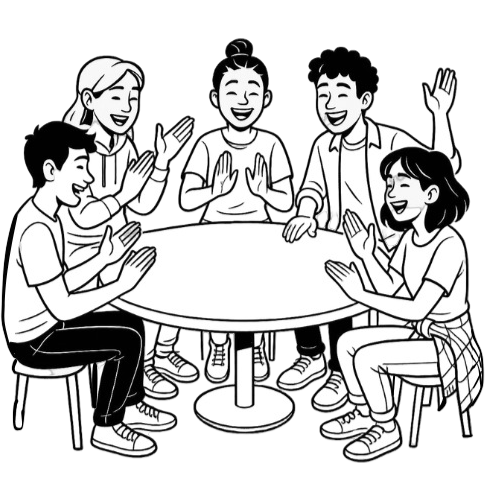
In this lesson, we’ll dive further into the world of tabletop rhythms by exploring the work of Joey Weisenberg, a musician known for blending Jewish musical traditions with creative rhythm-making. We’ll listen to how he uses simple surfaces—like tables—to create rich, layered beats that bring people together in song.
We’ll also recap the Panaderas rhythm, thinking about how it was used to support work and build community. Then, we’ll begin to experiment with composing our own rhythms, using our hands, voices, and creativity to build something new from these traditional roots.
Preparation:
Check and watch each of the video links and check they work and you understand each task.
Lessons are desk based but could be adapted to be on the floor.
Have workbooks and pens at hand.
Activity 1 - Warm up
1, 2, 3 Bradford – 5-10 mins
The game "1, 2, 3 Bradford" is a game used in both theatre and music-based group activity, often used in Augusto Boal’s, Theatre of the Oppressed workshops and music education settings. It’s a coordination game that builds rhythm, focus, and group cohesion.
You can teach the game and play it in pairs or you can play the teacher versus the rest of class.
Basic Rules:
Start the Sequence:
One person begins by saying “1”.
The next person (or class) continues with “2”.
It then goes back to the original person (teacher) who says “3”.
Repeat and Rotate:
After “3,” the next person starts again with “1,” and the cycle continues across the pair.
The rhythm should be steady and continuous.
Add Complexity (Optional):
Replace numbers with sounds or movements only.
Speed up the tempo.
Introduce mistakes as part of the fun—if someone messes up, they might do a silly forfeit or restart the round.
Activity 2 - Be Inspired
Joey Weisenberg - Tabletop Rhythm Intro – 15 mins
Joey Weisenberg is a musician, composer, and educator known for his innovative approach to Jewish music and communal singing. As the founder of the Hadar Ensemble, he blends traditional Jewish melodies with contemporary sounds and rhythmic experimentation. In this video he introduces his signature techniques using tabletop surfaces as percussion instruments—inviting people to tap, slap, and create rhythms together in a way that’s accessible, communal, and deeply musical.
Watch the video.
Ask the group to make some notes about what they notice during the video.
Ask the group to fill out section 6 of the workbook to support them to reflect on the video. Use the following questions for a group a discussion:
Joey talks about the space between the notes. What do you think he means by that? Can silence be part of music?
Joey says his stepfather told him “the world is not a drum.” Do you agree or disagree? Why?
Joey explores the sounds of different parts of the table with different parts of his hand. What sounds can you find on your table or desk? Which part makes the deepest sound?
What does Joey mean when he says music helps us connect with the world and feel amazed by the moment? Have you ever felt that way while listening or making music?
Activity 3 - Give it a go!
Joey Weisenberg Table Top Rhythm idea – 10 mins
This tutorial shows how Joey makes each individual table sound.
Watch the video and after he introduces each sound, pause the video and get the group to spend a minute trying out the sound.
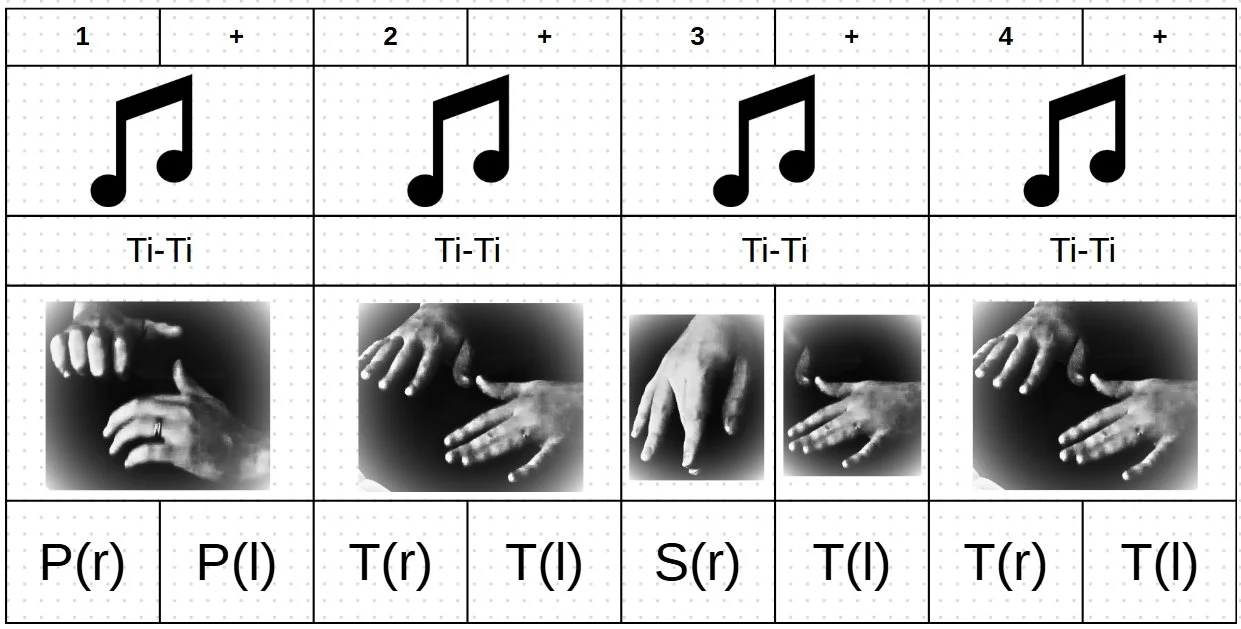
After watching the video, get the group to try and play the rhythm below. We use the letter P for palm, T for finger tips and S for the snap. (r) and (l) indicate right and left hand.
Start 1 beat at a time.
Use the rhythm sounds to help you. The pattern is Ti-Ti Ti-Ti Ti-Ti Ti-Ti and is a 4 beat pattern.
Start off slow and increase in speed, keeping a steady beat.
The trickiest element is beat 3 where you go from a snap on the right hand to a finger tip on the left. You might want to cycle beat 3 until it’s secure.
Let the group practice the rhythm individually before trying it as a group.
Below is the notated version of the rhythm.
Activity 4 - Ideas Time
Beats Beneath Your Fingers - 5 - 10 mins
Spend a couple of minutes as a group reflecting on the Panaderas Rhythm and the rhythms by Joey Weisenberg.
What were the different ways they made table top sounds?
Get the group to use section 7 of the workbook to write down all of the different ways you can make a sound as part of a table top rhythm.
Using section 8, can they create a simple image for each sound that can be used as some sort of graphic notation.