
Table Top Rhythms
Lesson 4
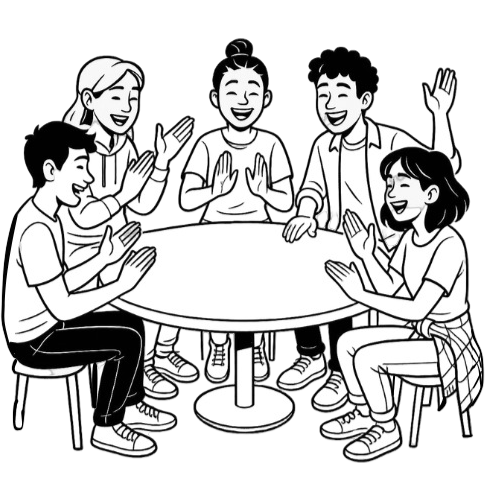
This fourth lesson focuses on fostering creativity by combining everything we've learned about tabletop rhythms so far. We'll use these skills to compose our own unique rhythms, drawing on traditional patterns and personal expression.
Preparation:
Check and watch each of the video links and check they work and you understand each task.
Lessons are desk based but could be adapted to be on the floor.
Have workbooks and pens at hand.
Activity 1 - Warm up
1, 2, 3 Bradford – 5 mins
Warm up the class with a quick game of 1,2,3 Bradford.
Try replacing numbers with table sounds. For example ‘3’ could be a palm.
Speed up the tempo.
Introduce mistakes as part of the fun—if someone messes up, they might do a silly forfeit or restart the round.
Activity 2 - Recap
Las Panaderas and Joey Weisenberg table top rhythms– 5 mins
A brief recap of the two different table top rhythm styles to provide inspiration for the following composition task.
Re-watch the Panaderas Video and the Joey Weisenberg Tutorial. As the group watch the video ask them to return to section 7 and 8 of the workbook adding any new ideas.
Activity 3 -Be Creative!
Tabletop Rhythm Compositions – 20 mins
Students will create a short rhythm piece using table top percussion inspired by Panaderas and Joey Weisenberg, and notate it using both graphic notation and standard Western rhythm notation.
Working in pairs the students should spend 5 minutes exploring different combinations of sounds and rhythms using their hands on tables to see what flows, sounds good or feels most comfortable.
Once students have some good ideas, they can start to fill in the rhythm grid in section 9. Use the following notes, in any order, to help:
How many beats is the rhythm going to be? Panaderas has 6 beats, Joey Weisenberg uses 4 beats.
What different sounds are you going to use? Eg. hand flips/finger snaps/claps?
What’s the rhythm going to be? Eg. Ta/Ti-Ti/Tika-tika think about which rhythm works well with which sound. Perhaps your rhythm is more complicated than the notation we have learned about, if so, how else can you remember your rhythm?
The group should spend the rest of the lesson practicing to play their rhythm.