Table Top Rhythms
Lesson 5
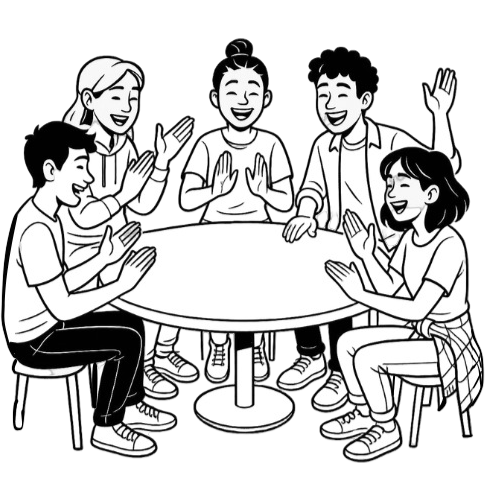
In this final lesson of our tabletop rhythms series, students will have the chance to rehearse and refine their own rhythm compositions before performing them for the rest of the group. This is a celebration of everything we've learned—drawing inspiration from Panaderas traditions, Joey Weisenberg’s creative use of everyday surfaces, and our own rhythmic ideas.
Through these performances, students will demonstrate a range of music skills including rhythmic accuracy, ensemble coordination, listening and timing, creativity, and musical expression. It’s also a chance to reflect on how rhythm connects us, communicates emotion, and transforms ordinary objects into instruments of collaboration and joy.
Preparation:
Make sure you have a means to record the group performances.
Lessons are desk based but could be adapted to be on the floor.
Have workbooks and pens at hand.
Activity 1 - Warm up
Don’t Clap This One Back – 5 mins
Warm up the class with a quick game of ‘Don’t Clap This One Back’.
Remember to use 4 of the following sounds in any combination for the claps: Ta, Ti-Ti, Tika-Tika
The two claps to remember are ‘don’t clap this one back’ and ‘if you here this, don’t clap back’.
Introduce mistakes as part of the fun—if someone messes up, they might do a silly forfeit.
Activity 2 - Recap
Table top rhythm composition practice – 15 mins
This practice period encourages creativity and confidence, enabling them to experiment with rhythms and refine their compositions effectively. Providing a supportive environment during this time fosters collaboration and ensures that each student can contribute their unique ideas.
Get the group into their composition pairs, with their workbooks at hand, and give them 15 minutes to practice and refine their compositions.
Remind them that we’re looking for steady pulse or beat whilst they perform and that movements should be coordinated. It’s not a race.
Whilst practicing it is good to use the following steps:
Review Your Rhythm
Go over your rhythm slowly. Clap it out or tap it on the table while counting the beats.
Practice with a Steady Pulse
Count out loud to keep a steady tempo. This helps with timing and coordination.
Break It Into Sections
Practice one part at a time, especially if your rhythm has different patterns or changes.
Listen to Each Other
Take it in turns in your pairs to perform and get feedback. One person could play and the other counts out the beats.
Add Dynamics and Expression
Think about how loud or soft each part should be. Joey Weisenberg talks about the space between sounds—use that to make your rhythm feel alive!
Practice Transitions
If your rhythm is already secure, try adding in a new section or a break. Rehearse how you’ll move smoothly from one part to the next.
Stay Relaxed and Focused
Take a deep breath before performing. Focus on the rhythm, the group, and the fun of making music together!
Activity 3 - Performance
Tabletop Rhythm Compositions – 20 mins
Students will now get a chance to perform their compositions to the rest of the class.
Create a performance space in the class, perhaps a desk at the front of the class with two chairs.
Ask each group to come up and perform their table top rhythm compositions. The pairs should try and cycle their rhythm 4 times without stopping. They should be thinking about maintaining a steady beat and coordinating their movements.
The rest of the class should be the audience and can think of one star (something they liked) and a wish (something they think can be developed) for the group that’s performing.
Following each performance ask the audience for a couple of pieces of positive feedback.
Activity 4 - Reflection
Table Top Rhythms: Reflection & Review – 5 mins
Ask the group to chat in talking partners reflecting about the last 5 lessons on table top rhythms. They can use section 10 in the workbook to make notes.
what were their strengths?
what did they find challenging?
what would they do different next time?
can they think of 3 things that they want to improve?
Can each person share one reflection that they discussed in pairs?